
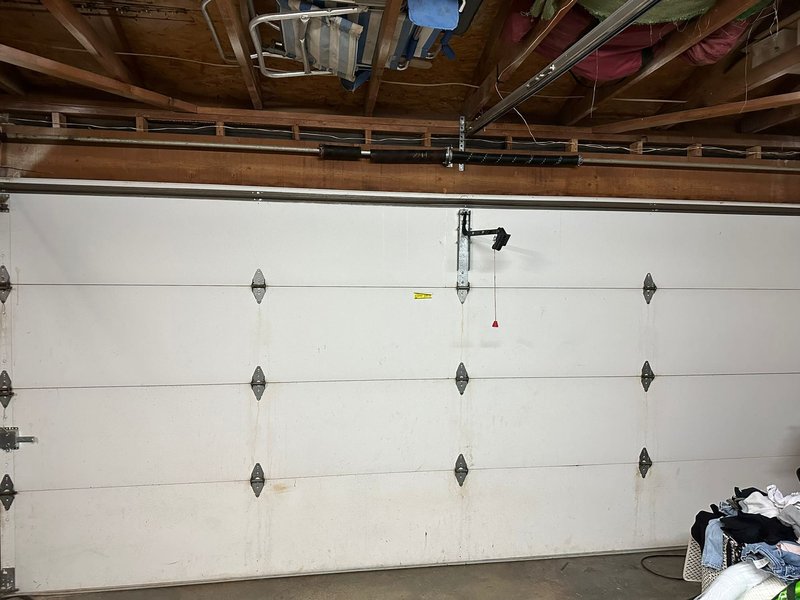
Most homeowners never think about their garage door springs until one snaps with a sound like a gunshot at 6 a.m., and suddenly the door won't budge. Torsion springs are the coiled steel components mounted on the horizontal shaft above your door. They store and release tension every single time the door moves, counterbalancing hundreds of pounds of door weight so your opener motor doesn't have to do it alone.
The 10,000-Cycle Baseline and Why It Doesn't Tell the Full Story
Spring manufacturers rate their products in cycles, where one cycle equals one complete open-and-close. The most common residential torsion spring is rated for roughly 10,000 cycles. A household that operates the garage door four times a day will hit that number in about seven years. Higher-grade springs are available at 25,000 or even 50,000 cycles, but most builders install the base-grade option to keep construction costs down, so if your home is more than six or seven years old and you have no idea when the springs were last changed, they may already be living on borrowed time.
That said, cycles are only one part of the equation. Metal fatigue is also driven by temperature swings, humidity, lubrication quality, and how much stress the spring is under when the door is closed. In the Inland Empire, all of those factors push wear faster than the cycle rating alone suggests.
How Riverside-Area Heat Accelerates Spring Wear
Garage interiors in Riverside, Moreno Valley, and the surrounding valley communities regularly hit 120°F or higher during summer afternoons, far hotter than a conditioned garage in a milder climate. Steel expands and contracts with temperature. Every day that a torsion spring heats up in a sun-baked garage and then cools overnight, the metal is working even when the door isn't moving. Over years, this thermal cycling creates microscopic stress fractures in the coil, especially near the ends where stress concentrates.
Santa Ana wind events compound the problem. Pressure differences can cause doors to partially open or slam, putting abrupt shock loads on springs that are already at the end of their rated life. If your door faces west or northwest (common in many Inland Empire tract developments), wind load is a real accelerant of wear.
The practical takeaway: a spring rated for 10,000 cycles in a moderate climate may behave more like a 7,000- to 8,000-cycle spring in your Riverside garage. Building in a proactive replacement margin is cheaper than an emergency call after a failure.
Warning Signs That Your Springs Are Near the End
Springs rarely give you a lot of warning, but they do give some. Watch and listen for:
- The door feels heavy when lifted manually. Disconnect your opener and try to lift the door by hand to waist height. A properly balanced door should stay at any height you leave it without rising or falling. If it drops, the springs are losing tension or are already broken.
- The opener strains or pauses mid-travel. When springs weaken, the motor must work harder. You may notice slower movement, hesitation, or the opener reversing as its force limits are triggered.
- Visible gaps in the coil. A broken torsion spring will show a clear gap (often an inch or more) somewhere along the coil. You can see this by looking at the spring while standing safely inside the garage with the door closed.
- Uneven movement or one side dipping. If you have two springs (standard on most two-car doors) and one breaks, the door will tilt to one side during travel, which can also cause the door to come off its track.
- Squeaking or grinding sounds. This often signals lack of lubrication rather than imminent failure, but dry springs wear faster. A squeaking spring that isn't lubricated regularly is shortening its own life.
Torsion vs. Extension Springs: Which Do You Have?
Torsion springs run horizontally above the door opening on a steel shaft. This is the setup on virtually all modern sectional doors installed in the last 15-20 years in Southern California tract homes. Extension springs, by contrast, run along the horizontal tracks on each side of the door. They're more common on older or lighter single-car doors.
Torsion systems are generally safer when a spring breaks, because the broken coil stays on the shaft. Extension spring failures can be more violent if safety cables aren't installed. The spring can fly across the garage. If you have extension springs without safety cables, ask about adding them during your next maintenance visit.
For most Inland Empire homeowners with a standard two-car sectional door, you have two torsion springs. When one breaks, we strongly recommend replacing both at the same time. They were installed together, have the same number of cycles on them, and the labor cost to do both simultaneously is far less than two separate service calls within months of each other.
Can You Replace Springs Yourself?
This question comes up constantly, and the honest answer is: you should not. Torsion springs are wound under extreme tension, enough force to cause serious injury or death if a spring, winding bar, or cable lets go unexpectedly. This is not a task where being handy with tools changes the risk profile. Professional technicians use calibrated winding bars, follow precise turn counts for each door's weight and height, and know how to safely release and reload tension.
Beyond safety, incorrectly wound springs cause premature failure, door imbalance, and opener damage. A spring wound to the wrong tension will either cause the door to slam open or drop without warning. Professional spring replacement ensures the springs are matched to your door's exact weight and that the system is properly balanced before the technician leaves. Repairs start around $240 and include a balance check of the full door system.
How to Extend the Life of Your Springs
You can't stop wear, but you can slow it down meaningfully with a few habits:
- Lubricate twice a year. Use a dedicated garage door lubricant (not WD-40, which is a solvent and will dry out the metal) on the spring coils, hinges, rollers, and bearing plates. In the Inland Empire, do this in spring before the heat arrives and again in the fall.
- Test door balance annually. The manual lift test described above takes 30 seconds and tells you immediately if the springs are losing tension.
- Don't force a struggling door. If the opener is laboring, stop using the door and call for service. Forcing a door with a weakening spring accelerates failure and risks damaging the opener.
- Upgrade to high-cycle springs when replacing. The incremental cost to step up from a 10,000-cycle spring to a 25,000-cycle spring is modest compared to the labor cost of an additional future replacement.
- Keep the garage ventilated. Anything that reduces peak interior temperatures (a vent, an insulated door, or even leaving a window open) reduces thermal stress on metal components.
When to Call for Service
If a spring has broken, don't try to operate the door. A garage door opener is not designed to move a door without functional springs, and forcing it risks burning out the motor, bending the top section of the door, or pulling the opener from the ceiling. Keep the door closed, do not drive through it, and call a technician.
If the spring is just showing wear signs (the door is slow, the balance test reveals a heavy door, or you can see corrosion on the coils), you have a short window to schedule a non-emergency replacement before it becomes an emergency. Our team is available around the clock for exactly these situations. Call (909) 264-7415 for a free on-site quote or book online at your convenience. You can also use our cost calculator to get a preliminary estimate before we arrive.
Staying ahead of spring wear is one of the highest-value things an Inland Empire homeowner can do for their garage. It costs less than an emergency call, protects the opener, and keeps the door balanced so it lasts longer overall.
Related services
When it is time to bring in a pro.