
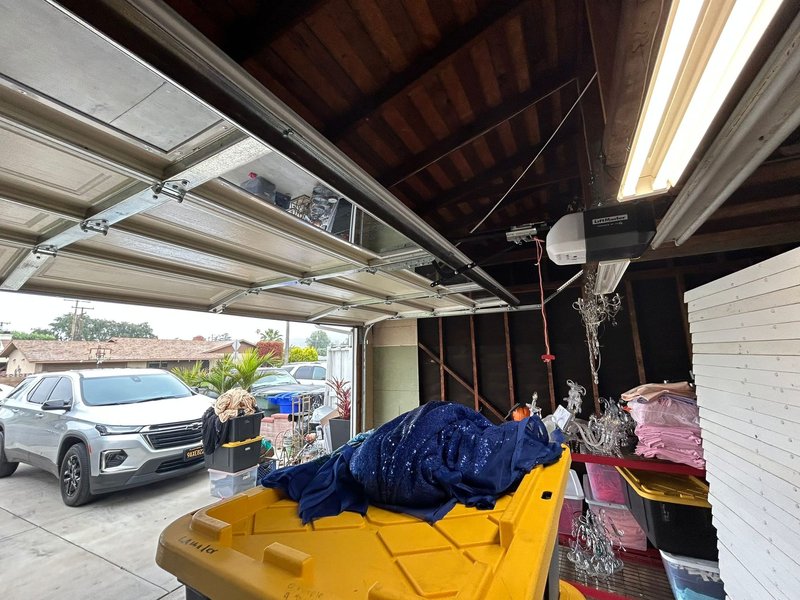
When your garage door moves up and down, you probably watch the panels, not the hardware. That is understandable. But the steel lift cables running along both sides of your door are doing a tremendous amount of work every single cycle. When one fails, the door can drop suddenly, come off its tracks, or refuse to move at all. In the Inland Empire, where summer heat can exceed 110 degrees and doors cycle dozens of times a week, cable wear accelerates faster than in cooler climates.
What Garage Door Cables Actually Do
A standard sectional garage door uses two lift cables, one on each side. Each cable wraps around a drum at the top of the door, then runs down to a bracket anchored at the bottom corner of the bottom panel. When the opener motor or the torsion spring releases tension, the drums rotate and wind or unwind the cables, raising or lowering the door in a controlled, balanced motion.
The cables do not work alone. They are paired with the torsion spring above the door, which stores and releases the energy that actually counterbalances the door's weight. Think of the spring as the engine and the cables as the drivetrain. If either component fails, the whole system fails. This is why a broken spring often damages cables at the same time, and why a snapped cable puts enormous sudden stress on the spring.
Warning Signs a Cable Is About to Fail
Cables rarely snap without warning. If you notice any of the following, stop using the door manually or with the opener and schedule an inspection:
- Visible fraying or rust: Steel cable strands fray from the outside in. Even a few broken strands mean the cable's rated capacity is already compromised.
- Cable slack on one side: If one side hangs loosely while the other is taut, the drum may have slipped or the cable anchor may have pulled free. The door is now unbalanced.
- Door tilts or hangs crooked: A lopsided door is almost always a cable or spring problem. Continuing to operate it risks jamming the panels into the tracks or causing the door to come off the rails entirely.
- Grinding or snapping sound during operation: A cable strand breaking mid-cycle sometimes makes a sharp crack. Do not ignore it.
- Door moves but feels heavy: If your opener strains noticeably or the door seems much heavier to lift manually than it used to, the cable tension or spring balance is off.
- Cable has jumped off the drum: This is a common result of a spring breaking. The cable unwinds chaotically and piles up instead of coiling neatly. The door is now unsafe to operate.
Why Cables Fail Faster in Riverside and the Inland Empire
Inland Empire homeowners deal with a combination of climate factors that are hard on steel cable:
Extreme heat: Prolonged exposure to temperatures above 100 degrees degrades the cable's outer galvanized coating faster than manufacturers rate for. Once the coating breaks down, the bare steel wire is exposed to moisture from morning condensation, which accelerates rust formation inside the cable strands where you cannot easily see it.
Santa Ana wind events: Strong wind pressure on the door panels creates lateral loads the cables are not designed to handle repeatedly. Over time this stresses the cable anchors and bottom brackets.
High cycle use: Many households in two-car tract homes cycle their garage door 10 to 20 times per day. A cable rated for 10,000 cycles can reach end of life in as little as two to three years in a busy household, especially if the door has never had a preventive maintenance visit to lubricate moving parts and check cable tension.
Concrete slab expansion: When slabs shift slightly, door frames can rack out of square. Even a quarter inch of misalignment changes how cable tension distributes across the drum and can cause one cable to wear dramatically faster than the other.
Can You Fix a Broken Garage Door Cable Yourself?
We get this question often, and the honest answer is: no, you should not attempt this repair yourself. Here is why:
Lift cables are under tension generated by the torsion spring, which stores a significant amount of mechanical energy. Releasing or adjusting that tension without the proper winding bars, experience, and safety equipment can cause the spring to unwind violently, resulting in serious injury. Even setting the spring aside, re-seating a cable correctly on the drum requires the drum to be in the exact right rotational position relative to the spring wind. If it is off by even one rotation, the door will be unbalanced, and the new cable will fail prematurely or cause the door to bind.
This is not a scare tactic. It is the same reason licensed pros use specific safety protocols for this repair. The components involved store real energy, and the tolerances matter. Compare it to changing a tire versus rebuilding a brake caliper: one is a sensible DIY task, the other is not.
If your cable has already snapped and the door is stuck open, do not attempt to force it closed manually. Call us at (909) 264-7415 and we can usually be there the same day. If the door is stuck down and your car is trapped inside, we treat that as an emergency and prioritize the call accordingly.
What the Repair Process Looks Like
When a technician arrives for a cable repair, the process typically follows these steps:
- Inspect both cables, both drums, the bottom brackets, and the spring to assess total damage. It is common for a spring failure to have caused the cable problem, so we never replace a cable in isolation without confirming the spring is healthy.
- Release spring tension safely using winding bars before touching any cable hardware.
- Remove the damaged cable and inspect the drum for wear or slipping. Drums that have grooved or cracked should be replaced at the same time, otherwise the new cable will wear quickly in the same spot.
- Install the new cable, seat it correctly on the drum, and re-tension the spring to the manufacturer specification for the door's weight and height.
- Test the door through several full cycles, check balance by disconnecting the opener and lifting by hand (a balanced door should stay put at mid-height), and lubricate all moving parts.
Cable repair starts around $240 and the price varies based on whether drums, bottom brackets, or springs also need replacement. We provide a written, itemized quote before starting any work, so there are no surprises on the invoice. You can also use our cost calculator to get a rough estimate before we arrive, or book a free on-site quote at your convenience.
How to Extend the Life of Your Cables
Cables are a wear item, not a lifetime component, but you can significantly extend their service life with a few habits:
- Have the door professionally lubricated and inspected once a year. A technician will catch fraying cables before they snap and adjust drum tension so both sides wear evenly.
- Never operate a door that is binding, making unusual sounds, or visibly crooked. Forcing the opener through resistance is the fastest way to damage cables and drums simultaneously.
- If a spring breaks, stop using the door immediately. The cable on the broken-spring side will rapidly unspool and tangle if you keep cycling the door.
- Keep the tracks clean and the rollers in good shape. When rollers bind in the tracks, the cable has to absorb the extra load, which shortens its life.
Regular maintenance visits are the single best investment you can make to avoid emergency cable calls. A technician can spot a fraying cable during a routine visit, order the replacement part, and schedule the swap before the cable becomes a problem. That is far less stressful than discovering the door will not open when you are already late for work.
Related services
When it is time to bring in a pro.