If you have lived through a Santa Ana wind event or one of Southern California Edison's Public Safety Power Shutoffs, you know the routine: the lights go out, the neighborhood goes quiet, and the garage door that works perfectly every other day will not budge. After the 2017 wildfires, California decided that was a life safety problem, not an inconvenience, and wrote a law to fix it. We install and repair openers across Riverside, Moreno Valley, Corona, and the rest of the Inland Empire every week, and homeowners ask about this law constantly. Here is the whole picture in plain English.
What SB 969 actually requires
The law is Senate Bill 969, authored by State Senator Bill Dodd and signed in September 2018. It amended Section 19891 of the California Health and Safety Code and added Section 19892. The core requirements took effect on July 1, 2019, and they are refreshingly simple:
- Battery backup is mandatory on new units. No one may manufacture for sale, sell, offer for sale, or install a residential automatic garage door opener in California unless it has a battery backup function designed to activate during an electrical outage.
- The door must keep working. The battery backup must keep the opener operational without interruption during the outage. The door has to actually open and close.
- Replacement doors are covered too. A replacement residential garage door may not be installed and connected to an existing opener that lacks battery backup. New door, compliant opener, no exceptions.
- There are real penalties. The statute sets a civil penalty of $1,000 per non-compliant opener manufactured, sold, offered for sale, or installed.
Notice who the law targets: manufacturers, retailers, and installers, not homeowners. You will not be fined for owning an older opener. But any legitimate company working on your home is bound by it, which is why we install battery backup units on every opener repair and installation job in Riverside.
Why California passed the law: the 2017 wildfires
SB 969 was born out of tragedy. The 2017 wildfire season was one of the deadliest in California history, and when the October 2017 fires tore through Northern California, hundreds of thousands of homes lost power as residents tried to evacuate at night. Several of the people who died that month were found in or near their garages: the power was out, the opener was dead, and they could not get the door open to drive away. Senator Dodd, who represented the fire-hit region, has said he struggled with his own door while evacuating and got out only with a neighbor's help.
A double garage door can weigh hundreds of pounds, and lifting one by hand in the dark, under smoke and stress, is a real barrier for many people, especially seniors. The legislature's answer was simple: if the opener is how most people operate the door, the opener needs to work when the grid does not.
Why this matters more in the Inland Empire than almost anywhere
This is not an abstract Sacramento rule out here. The Santa Ana winds funnel through the Cajon and San Gorgonio passes every fall, and communities from the Rancho Cucamonga foothills to Yucaipa, Banning, Beaumont, and Lake Elsinore live with red flag warnings as a seasonal fact of life.
That same fire weather triggers SCE's Public Safety Power Shutoffs, where the utility deliberately de-energizes lines during high winds to prevent ignitions. A PSPS can last hours or days, and unlike a random blackout, it arrives at exactly the moment you may need to leave in a hurry. Add the routine summer outages during heat waves, and a battery backup opener stops being a legal checkbox and becomes one of the cheapest pieces of emergency equipment in your house.
How to check whether your opener complies
Not sure where you stand? This check takes five minutes:
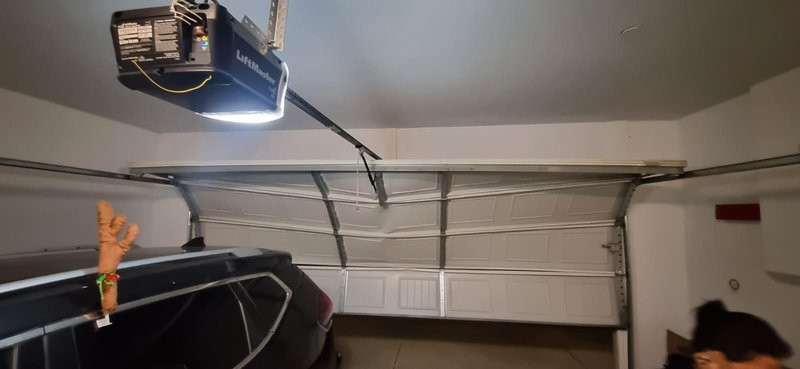
- Look at the motor head. Battery backup units have a visible battery compartment, usually a removable panel on the housing, and most have a battery status LED on the unit or wall console.
- Check the age and model. If the opener was bought and installed in California after July 1, 2019, it should already comply. The model number printed on the housing plus a quick manufacturer lookup settles it for older units.
- Do the unplug test. Unplug the opener and press your remote. If the door runs, your battery backup works. If nothing happens, you have no battery or a dead one.
- Listen for beeping. A compliant opener that chirps periodically is usually telling you it is running on battery power or that the battery has reached the end of its life and needs replacement.
That third step matters even for compliant openers. Backup batteries typically last about one to three years, and a dead battery quietly recreates the exact problem the law was written to solve. We test it on every tune-up for this reason.
What actually happens during an outage
With battery backup
The handoff is automatic. The opener switches to the battery the instant power drops, and the door opens and closes from your remotes and keypad as usual, safety sensors still active. Manufacturer ratings for current LiftMaster and Chamberlain units are typically around 20 open and close cycles in the first 24 hours of an outage, far more than a family needs to get vehicles out and secure the house. The unit beeps and shows an LED while on battery so you know you are running on reserve.
Without battery backup
You are down to the red emergency release cord. Pulling it disconnects the trolley from the door so you can lift it by hand. That is fine on a light, well-balanced door and genuinely hard on a heavy insulated double door in the dark. If a spring is broken or weak, the door can be close to impossible to lift safely, and a disengaged door is a security problem until it is re-engaged and locked. If the door will not lift with reasonable effort, stop forcing it and call our emergency garage door repair line, forcing a bound or broken door is what causes the expensive damage.
Every September, before the Santa Ana winds arrive, unplug your opener and run the door once on battery. That 60-second test tells you whether your backup will be there during a shutoff. If the door hesitates or fails, the battery is due. Call or text us at (909) 264-7415 and we can replace it on the spot.
Upgrading: what a compliant opener looks like in 2026
Here is the good news: complying with SB 969 does not mean settling. The same engineering that enables battery backup, a DC motor instead of the old AC style, also gives you soft start and stop and much quieter operation. The units we install most are LiftMaster and Chamberlain belt-drive models with the battery integrated right into the motor housing, no external box, no extra wiring. Almost all now include Wi-Fi and the myQ app, so your phone tells you when the door was left open and shows battery status. Our smart garage door opener installation service covers setup end to end, and our roundup of the best garage door openers for 2026 compares the current LiftMaster, Chamberlain, and Genie lineups in detail.
If your opener predates 2019, it is likely 10 to 20 years old, with worn gears and dated security. The battery backup law is often simply the nudge to do an upgrade that already made sense, and our guide to upgrading your garage door opener walks through the signs it is time.
What it costs
Because battery backup is now standard on every opener sold in California, you are not paying a premium for compliance, it is simply built into the price of a modern unit. The installed cost depends on drive type (belt drives cost a bit more than chain drives and are much quieter), motor power for heavier doors, rail length for taller doors, and smart features. The backup battery is the only recurring cost, an inexpensive part that takes minutes to swap when it ages out. As with every job we do, you get an itemized quote before any work starts, and the estimate is free. If the door is as tired as the opener, read our top 10 things to know before replacing a garage door or opener so you can plan the project once instead of twice.
Frequently asked questions
These are the SB 969 questions we hear most often from Inland Empire homeowners. More answers live on our FAQ page.
Do I have to upgrade my existing opener to comply with SB 969?
No. The law is not retroactive, so an opener installed before July 1, 2019 can legally stay in service. The requirement applies at the point of sale or installation: any new or replacement opener must have battery backup, and a replacement garage door cannot be connected to an old opener that lacks it.
Can I add a battery backup to my old opener instead of replacing it?
Usually not. Most older AC-motor openers were never designed to run on battery power, so no kit makes them compliant, though a few newer models accept a manufacturer battery accessory. Text us the model number off the motor housing and we can tell you in minutes which route makes sense.
How long does the battery actually last during an outage?
Typically around 20 open and close cycles within the first 24 hours of an outage, per current LiftMaster and Chamberlain ratings. The battery itself serves about one to three years, and the opener beeps to warn you when it is getting weak.
Will my door still open manually if I have no battery backup?
Yes, the red emergency release cord disconnects the door from the motor so you can lift it by hand. But a heavy or out-of-balance door, or one with a broken spring, may not lift safely. If the door resists, stop and call a tech rather than forcing it.
Does the law apply to driveway gates or commercial doors?
No, SB 969 covers residential automatic garage door openers only. Gate operators and commercial overhead doors are outside the statute, though battery backup options exist for most modern gate operators and are worth adding for the same evacuation reasons.